

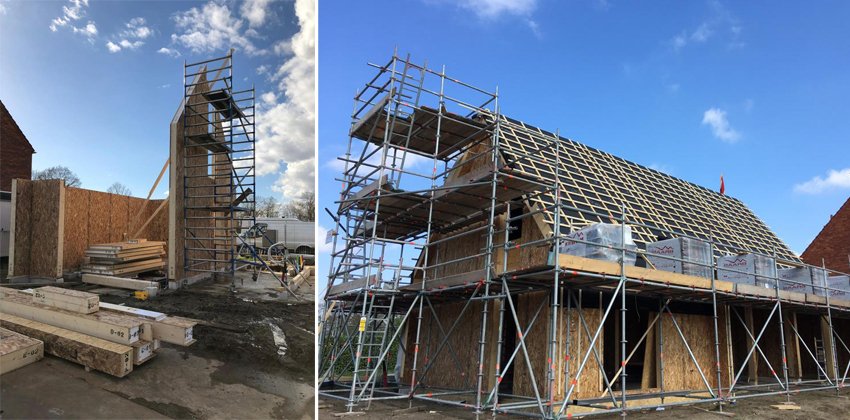
Acoustics and Fire Safety in SIP Buildings Explained
Acoustics and Fire Safety in SIP Buildings
When developers or homeowners think of Structural Insulated Panels (SIPs), they often mention speed of construction and energy efficiency first. However, two other aspects are just as important: acoustics and fire safety. These factors determine whether a building is safe, comfortable and compliant with European standards.
This article explains how SIPs perform in both areas, what certifications they meet in Europe, and why they are a reliable choice for residential and commercial projects.
Acoustic Performance of SIPs
Acoustic comfort is an essential part of modern living. Whether in a city apartment, a family home or a holiday cabin, occupants expect quiet and privacy. SIPs deliver excellent sound insulation thanks to their solid composite structure.
How SIPs Reduce Noise
- Solid Composite Panels: OSB facings bonded to an insulated core form a dense wall with very few cavities where sound can travel.
- Neopor® Insulation Core: The expanded polystyrene core absorbs and dampens airborne sound.
- Airtight Joints: Precision manufacturing and sealed connections eliminate gaps that could cause sound leakage.
Measured Performance
Independent tests across Europe show that SIP wall assemblies typically achieve Rw values between 40 and 50 dB, which is sufficient for most residential buildings. With additional finishes such as acoustic plasterboard or exterior cladding, this value can exceed 55 dB, making SIPs suitable for schools, offices and multi-family housing.
Typical Applications
- Urban housing: reduces external traffic noise.
- Multi-unit developments: limits sound transfer between dwellings.
- Hospitality projects: ensures quiet and comfortable guest spaces.
Fire Safety in SIP Buildings
Fire safety is one of the most critical aspects of any construction system. SIPs are carefully designed and tested to meet strict European fire resistance standards, ensuring both safety and compliance.
How SIPs Respond to Fire
- OSB Facings: Fire-retardant OSB layers provide initial protection.
- Neopor® Core: Contains flame-retardant additives that slow ignition and reduce flame spread.
- Composite Structure: The bonded system delays structural failure and limits oxygen access.
Fire Resistance Ratings
Certified tests show that SIP walls and roofs can achieve REI 30 to REI 60, depending on panel thickness and internal finishes. Adding a double layer of gypsum board can extend this to REI 90, offering protection comparable to traditional masonry walls.
European Standards
Quacent SIP systems are tested according to EN 1365 and EN 13501. They meet the requirements for residential buildings and can be adapted to stricter commercial or institutional applications.
Addressing Common Misconceptions
“Aren’t SIPs just foam and wood?”
No. SIPs are engineered structural systems that combine tested materials and precise detailing for strength, fire safety and acoustic control.
“Do SIPs burn easily?”
No. The Neopor® core is flame-retardant, and the OSB skins char instead of igniting quickly. With interior gypsum lining, SIP walls resist fire spread very effectively.
“Are SIPs noisy?”
Not at all. SIPs often outperform timber-frame walls of similar thickness in reducing airborne sound.
Enhancing Performance
Although SIPs already perform very well, designers can improve them even further:
- Double-layer gypsum board increases fire resistance.
- Acoustic layers or resilient channels improve sound insulation.
- Exterior claddings such as brick, stone or fiber cement add both sound insulation and fire resistance.
These solutions allow architects to customize SIP assemblies to meet specific project requirements.
The Quacent Advantage
Quacent SIP systems are developed to combine safety, comfort and full compliance:
- Neopor® core with integrated flame-retardant additives.
- Factory precision for airtight joints and excellent acoustic control.
- Comprehensive technical support to achieve required fire ratings.
- Full EU documentation with certified test reports.
By supporting contractors and architects, Quacent ensures that every SIP project meets the highest European standards for both fire safety and acoustic performance.
Looking Ahead
As European building codes become more demanding, the importance of acoustic and fire safety continues to increase. SIP technology is evolving at the same pace, with better finishes, smarter detailing and growing recognition among professionals.
SIPs are already proving their value in multi-family housing, schools and commercial buildings, where performance and safety are essential.
Conclusion
SIPs offer much more than speed and efficiency. They provide verified performance in fire resistance and acoustic comfort, meeting the most demanding European standards while creating safe, quiet and sustainable buildings.
For developers, builders and architects, SIPs by Quacent represent a proven and modern solution that combines innovation, comfort and reliability. They are the trusted foundation for the future of European construction.